500 Book Reviews + 500 Book Reviews 80% Reviews Published Professional ReaderCamp NetGalley 2024Camp NetGalley 2025Frequently Auto-Approved
Showing posts with label Jazz Age. Show all posts

Sunday, March 27, 2022

Last Call at the Nightingale , by Katharine Schellman


Vivian sees things she shouldn't, in a place she shouldn't be.

To be honest, I think my response to this book was colored by a book set in the same era that I read recently. Author Katharine Schellman does an excellent job setting the scene. You can almost feel the sweat pouring off bodies, the crowded dance floor, and the quiet desperation of many of those at the Nightingale. Vivian, a working class Irish lass, bisexual, finds escape from her harsh reality at the club and winds up being the one to find a dead body in the alley behind the club. The dark side of the Jazz Age, with prohibition and the frequently almost forced exuberance of the era shine forth throughout the book. The characters are nicely introduced and include different races, creeds, and sexual leanings. Wealth and the role of women during the Jazz Age, not to mention the early 1900's in America, are brought out, as are the various prejudices of the times. In other words, there is a great deal going on in this book.

Despite the dark tone of the setting, again perhaps because of my previous readings and being a history major, I liked Vivian and sympathized with her situation. Many of my ancestors probably lived similar lives, making it all the more real to me as a reader. Vivian's pursuit of the truth took courage and the murder, in a weird way, took a backseat for me as the story progressed because of the bigger picture of the times. The world was already harsh and full of secrets for a relatively innocent girl like Vivian, making her courage all the more impressive. She's trying to survive but have some fun, too, and winds up caught up in a murder investigation. She even gets arrested at one point but is bailed out by friends she's made at the Nightingale. We should all deserve such friends.

I won't detail the plot, it's easily accessible in many places, but it moved along from the first page. As noted, the author does an excellent job of setting the scene and the alternating senses of hope, despair, and fear that underlie the plot. Caught between the secrets of those who inhabited the Nightingale, the whims and lack of care from those of a higher status, where lives like hers might be considered irrelevant, Vivian emerges as a strong woman in a time when strong women weren't the norm. Thus, read this one as much for a look at a dark period of American history, the roles of women, and the differences between social levels as a mystery. If you enjoy history, you'll enjoy this book and maybe, like me, find yourself looking up "The Great Gatsby" and discovering it was written the year this book is set in, only a year after the Charleston took the world by storm.

Thank you, #NetGalley and #StMartinsPress for this thoughtful, occasionally troubling bit of time travel back into an era that looked so delightful on the surface but was full of darker undertones. Oddly enough, I enjoyed it.
Tuesday, March 8, 2022

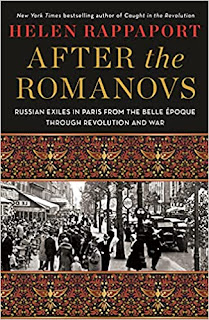
After the Romanovs: Russian Exiles in Paris from the Belle Époque Through Revolution and War, by Helen Rappaport


"After the Romanovs" opens in a relatively light fashion as wealthy Russians, among them Romanovs, enjoy vacations and visits to France. Paris is a playground for them. Artists of all kinds flock there to rub shoulders with the elite of the world. Stars like Nijinsky shine. Intellectuals sought both rest and creativity, some even rubbing shoulders with a Russian visitor named Lenin. Yes, that Lenin.

Needless to say, the tone of the book switches gears quickly after the Russian Revolution and assassination of the Tsar and his family. The Romanovs were now targets for the new regime. Many of those who once sought amusement or simply enjoyed the thriving creativity to be found in Paris found themselves fleeing to Paris once again, this time as refugees. Now largely penniless and unable to find work, this is their story. Even the mysterious Anastasia makes an appearance in the book.

Watching this history unfold was at once both saddening and fascinating. The emotions of those in exile swung wildly from optimistic and hopeful for a return to Russia to lost and simply desperate to survive. Few had any practical skills and they were cut off from the past fortunes. The manner in which the French accepted them, of course, also varied. The Jazz Age occurred post revolution but the emigres, many of whom had never worked a day in their lives, were usually too busy trying just to stay alive with a roof over their heads and something to eat and wear, to be caught up in it. Interestingly enough, it was some of the female emigres who perhaps came closest, particularly those who found employment with Chanel or in the garment industry. Former duchesses found themselves doing piecework and embroidering to support their families. You might find yourself being seated at a ritzy restaurant by a former duke or driven about town by a taxi driver with royal connections. Rappaport writes at one point that the unifying thread between them all seemed to be a "solidarity in poverty". Starvation and suicide were common.

Even though I found it a bit difficult to keep the names straight in my head -- I found myself scrolling back-and-forth frequently -- I found the book fascinating. The author has done extensive research and the amount of information she shares is almost staggering. You'll also see the birth of the current communist society which, even then, especially after Stalin's ascent, used spies and kidnapping to its benefit both against its own countrymen and the Russian emigres. There's much to take in here and kudos to author Rappaport for sharing her research with us in such a readable fashion.

Thanks to #NetGalley and #StMartinsPress for the ARC. Even as a former history major and teacher, I came away with not just a more thorough knowledge of the post Russian Revolution emigres but history in general.

Murder Stage Left (A Lady Eleanor Swift Mystery, #26), by Verity Bright

  Publication Aug. 26, 2026 England, 1926. This is another one of my favorite series. You know, one of those that as a reviewer I request wi...